A pillow might seem like a small detail in your bedroom, but anyone who has spent the night tossing, turning, and trying to get comfortable knows how much it matters.
Maybe your current pillow feels great when you first lie down but goes flat by morning. Maybe you wake up with a stiff neck, or you keep folding your pillow in half to get enough support. Or perhaps you're shopping for a new one and can't figure out whether memory foam, latex, down, or an adjustable pillow is worth your money.
The good news? You don't need the most expensive pillow on the shelf. You need one that works with your body, your mattress, and the way you actually sleep.
This guide explains how to choose a pillow without getting overwhelmed by marketing claims, confusing materials, or endless product options.
The Quick Answer: What Kind of Pillow Do You Need?
Start with your usual sleeping position.
Swipe or scroll to compare all columns
Sleeping position | Starting point | What matters most |
|---|---|---|
Side sleeper | Medium-high to high loft, medium-firm to firm support | Filling the space between your shoulder and head |
Back sleeper | Medium loft, medium support | Supporting your neck without pushing your head forward |
Stomach sleeper | Very low loft, soft and compressible | Avoiding excessive upward bending of the neck |
Combination sleeper | Adjustable or medium-loft pillow | Comfortable support as you change positions |
These are starting points, not universal rules. Your shoulder width, body proportions, mattress firmness, and personal comfort all affect the ideal pillow height.
The simplest rule: Choose a pillow that keeps your head comfortably aligned with the rest of your spine when you're in your normal sleeping position.
Why Choosing the Right Pillow Matters
Think about what happens when you lie down.
Your mattress supports most of your body, but your head and neck need support too. If your pillow is too tall, it may push your head into an uncomfortable angle. If it's too thin, your head may drop toward the mattress.
Either situation can create unnecessary strain.
A well-fitting pillow should support your head and neck without forcing them into an awkward position. It should also feel comfortable enough that you're not constantly adjusting it throughout the night.
That doesn't mean a new pillow will automatically solve neck pain, headaches, or poor sleep. Those problems can have several causes. But if your current pillow is uncomfortable or no longer supportive, replacing it is a reasonable place to start.
1. Start With Your Sleeping Position
Your sleeping position is usually the most useful clue when choosing a pillow.
Best Pillow Characteristics for Side Sleepers
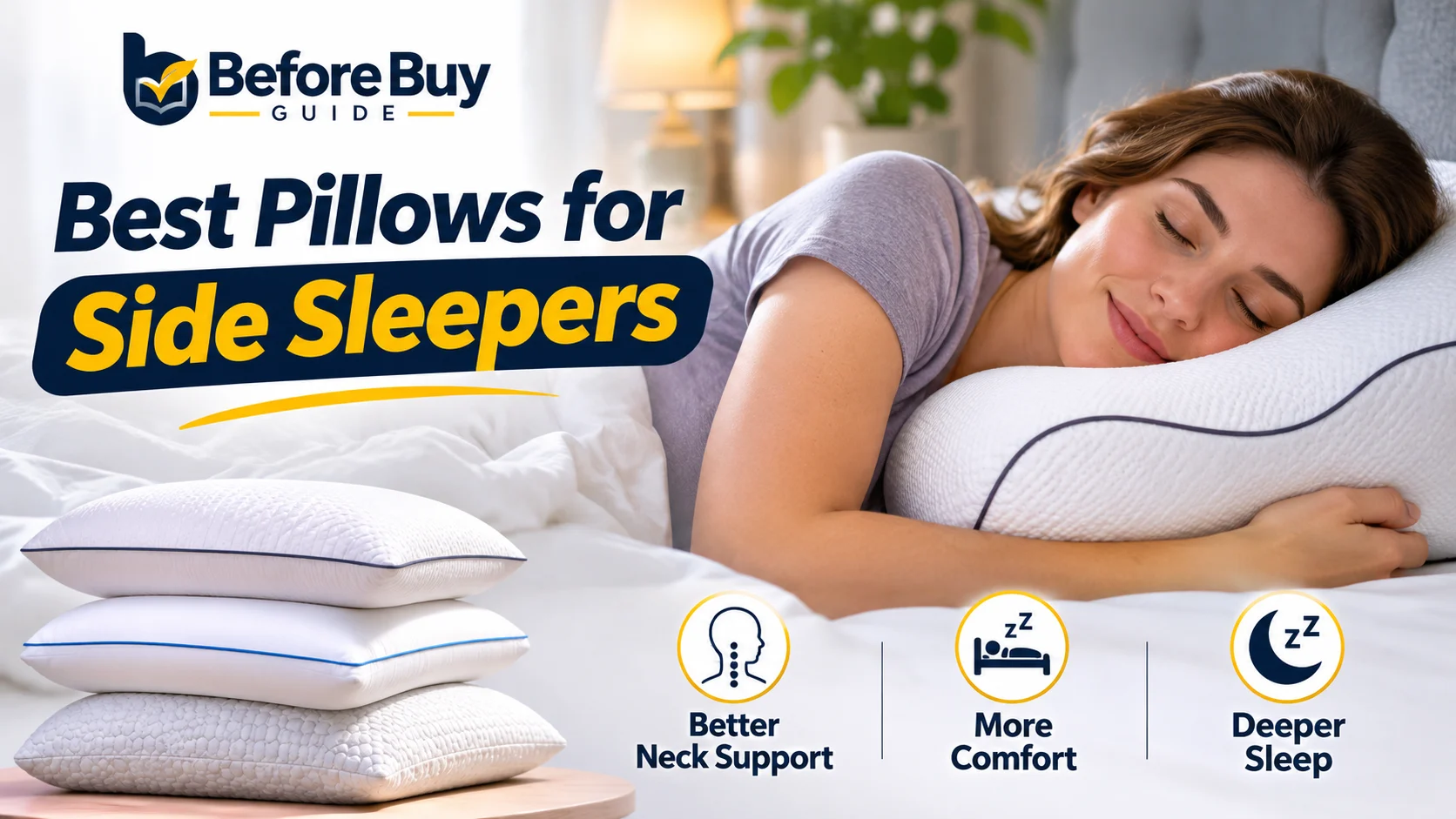
If you sleep on your side, there's a gap between your head and the mattress created by your shoulder.
Your pillow needs enough height and support to fill that space.
A pillow that's too thin may allow your head to tilt downward. One that's too tall may tilt your head in the opposite direction.
What to look for:
Medium-high or high loft, depending on your shoulder width and mattress.
Enough firmness to prevent the pillow from collapsing.
Consistent support throughout the night.
An adjustable fill if you're unsure about the right height.
Memory foam, latex, and adjustable shredded-foam pillows can all be worth considering.
Here's a practical way to check the fit: Lie on your side and have someone look at your head and neck from behind. Your neck should appear comfortably in line with your upper back, rather than bending noticeably up or down.
Don't assume every side sleeper needs an extra-thick pillow. If you have a softer mattress that allows your shoulder to sink deeply, you may need less pillow height than someone sleeping on a firm mattress.
Best Pillow Characteristics for Back Sleepers
Back sleepers generally need a pillow that supports the natural curve of the neck without lifting the head too far forward.
A pillow that's excessively thick can leave your chin angled toward your chest. A very flat pillow may not provide the support you prefer beneath your neck.
A medium-loft pillow is often a sensible starting point.
Consider a pillow that:
Gently cradles your head.
Supports the curve of your neck.
Doesn't force your chin downward.
Maintains its shape during the night.
Some back sleepers like contoured cervical pillows. Others are more comfortable with a traditional pillow that has a supportive but compressible fill.
Neither style is automatically better. What matters is how it fits your neck and how comfortable you feel using it.
Best Pillow Characteristics for Stomach Sleepers
Stomach sleeping presents a different challenge.
Because your head is usually turned to one side, your neck is already rotated. Adding a thick pillow can increase the amount of extension at your neck.
If you regularly sleep on your stomach, consider a very thin, soft pillow. Some stomach sleepers prefer little or no pillow beneath their head.
The goal is to avoid lifting your head unnecessarily.
If you frequently wake up with neck discomfort, experimenting with a different sleeping position may also be worth considering.
What if You Change Positions During the Night?
You don't need to stay in one position all night to choose a good pillow.
Think about the position you fall asleep in most often and the one you tend to wake up in.
If you switch between your back and side, a medium-loft adjustable pillow may give you more flexibility than a very thick, firm pillow.
You can also look for a pillow with a responsive fill that adapts when you move rather than staying rigidly in one shape.
For combination sleepers, adjustability is especially useful because it gives you room to experiment without immediately buying another pillow.
2. Understand Pillow Loft and Firmness
Two pillows can look almost identical on a store shelf and feel completely different once you lie on them.
That's because pillow height and firmness are not the same thing.
What Is Pillow Loft?
Pillow loft refers to the pillow's height or thickness.
You'll often see pillows described as low, medium, or high loft.
Some brands use measurements such as:
Low loft: Under approximately 3 inches.
Medium loft: Around 3–5 inches.
High loft: Above approximately 5 inches.
These are general shopping descriptions, not standardized industry categories.
More importantly, the height printed on a product page isn't necessarily the height you'll experience while sleeping.
A fluffy 6-inch pillow might compress substantially under your head, while a denser 4-inch foam pillow may maintain most of its height.
Focus on the pillow's compressed height, not just how thick it looks.
What Is Pillow Firmness?
Firmness describes how much a pillow resists pressure.
A soft pillow allows your head to sink more deeply. A firmer pillow resists compression and may maintain its height more consistently.
Neither is inherently better.
A pillow can be soft and tall, firm and thin, or somewhere in between.
For example, a side sleeper may enjoy a plush surface but still need enough underlying support to prevent their head from sinking too far.
This is why shopping based on labels such as "ultra-soft" or "extra-firm" alone can be misleading.
3. Compare Different Pillow Materials
Once you've narrowed down the height and support you need, it's time to think about what's inside the pillow.
Different materials affect cushioning, responsiveness, temperature, maintenance, and durability.
Memory Foam Pillows
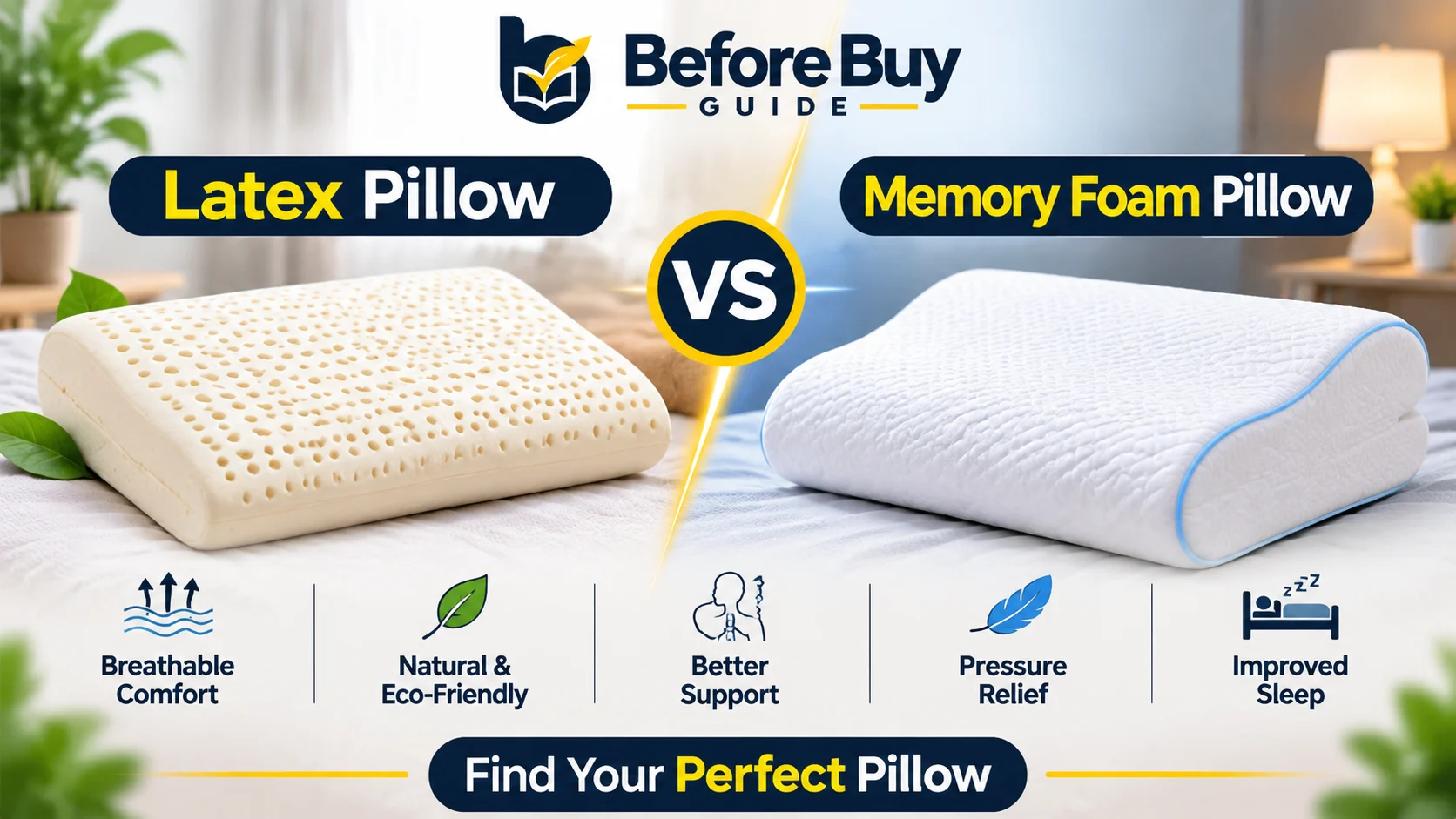
Memory foam responds to pressure and gradually contours around your head and neck.
It can be a good option if you prefer a more molded, cradling sensation.
Advantages:
Contouring support.
Available in traditional and ergonomic shapes.
Solid foam models often maintain a consistent shape.
Potential drawbacks:
Some models retain warmth.
Solid foam can be difficult to adjust.
Certain foams have a noticeable initial odor.
If you like the feel of memory foam but want more control over pillow height, consider a shredded memory foam model with removable fill.
Latex Pillows
Latex pillows tend to feel springier and more responsive than traditional memory foam.
Instead of slowly molding around your head, latex generally pushes back more quickly.
This can appeal to people who move around frequently at night.
Advantages:
Responsive support.
Often maintains its shape well.
Some designs have ventilation features.
Potential drawbacks:
Can feel too bouncy or firm for some sleepers.
Often costs more than basic polyester pillows.
Weight and washability vary by model.
If you have a known latex allergy, review the product materials and consult your clinician before choosing a latex pillow.
Down Pillows
Down pillows are filled with soft clusters found beneath the outer feathers of ducks or geese.
They're often chosen for their plush, moldable feel.
You can fluff, fold, or reshape many down pillows to suit your preferences.
However, a very soft down pillow may compress too much for someone who needs substantial neck support.
Down can work well if you prioritize softness and enjoy adjusting your pillow throughout the night.
Check the manufacturer's sourcing and cleaning information if animal welfare or maintenance is important to you.
Down Alternative Pillows
Down alternative pillows typically use synthetic fibers designed to create a soft, fluffy feel.
They're widely available in US department stores, bedding retailers, and online marketplaces.
Many are relatively affordable, and some are machine washable.
The trade-off is that certain fiber-filled pillows can flatten or develop lumps over time.
If you're considering one, pay attention to how quickly it regains its shape after compression.
Buckwheat Pillows
Buckwheat pillows contain small hulls that shift and settle around your head.
They have a distinctive, firm, adjustable feel.
Some people appreciate their stable support and airflow, while others find them too heavy, noisy, or firm.
They're quite different from traditional fluffy pillows, so they're worth trying before committing if possible.
Which Pillow Material Is Best?
There isn't a single winner.
Swipe or scroll to compare all columns
Material | Typical feel | Best reason to consider it |
|---|---|---|
Memory foam | Contouring, slow response | You like a cradled feeling |
Latex | Springy, responsive | You want support that rebounds quickly |
Down | Soft, moldable | You prefer plush comfort |
Down alternative | Fluffy, compressible | You want an accessible, often lower-cost option |
Buckwheat | Firm, shapeable | You prefer a structured, adjustable surface |
Rather than asking which material is the best overall, ask which material offers the support and feel you actually enjoy.
4. Don't Forget About Your Mattress
Here's something many pillow shoppers overlook: your mattress changes how a pillow fits.
Imagine lying on your side on a firm mattress. Your shoulder may stay relatively high, leaving a larger gap between your head and the bed.
Now imagine lying on a soft mattress. Your shoulder may sink farther into the surface, reducing that gap.
The same pillow may feel too low on one mattress and too high on the other.
That's why you shouldn't choose pillow height based on sleeping position alone.
If possible, test a new pillow on your actual mattress before deciding whether it fits.
This also explains why a pillow that worked perfectly with your old mattress may suddenly feel uncomfortable after you replace your bed.
Your body proportions matter too. Someone with broader shoulders may need more pillow height when side sleeping than someone with narrower shoulders, assuming similar mattress sinkage.
5. How to Test Whether a Pillow Is Right for You
You don't need specialized equipment to evaluate a pillow.
Try this simple at-home test.
Step 1: Lie Down in Your Normal Sleeping Position
Don't test your pillow while sitting upright or holding it against your face in a store.
Lie down as you would when going to sleep.
Give your head and shoulders a moment to settle into the mattress.
Step 2: Check Your Neck Position
Pay attention to whether your head feels pushed upward, pulled downward, or comfortably supported.
For side sleeping, look for a relatively straight line through your neck and upper back.
For back sleeping, your head should rest comfortably without your chin being forced toward your chest.
Step 3: Notice How Much You Need to Adjust It
Do you constantly fold the pillow?
Do you slide your hand underneath it for more height?
Does your head sink so deeply that the pillow feels almost nonexistent?
These are useful clues that the height or support may not match your needs.
Step 4: Test It for More Than a Few Minutes
A pillow can feel wonderful for five minutes and uncomfortable after several hours.
If the retailer offers a trial or return period, use that opportunity to evaluate the pillow across multiple nights.
Check the terms before buying. Some retailers exclude opened bedding from returns.
Step 5: Pay Attention to Your Mornings
Notice whether you're waking up comfortable or regularly experiencing stiffness.
Don't judge a pillow based on one unusual night. Consider the pattern over time.
If you experience persistent, worsening, or severe neck pain, numbness, weakness, or other concerning symptoms, seek medical advice rather than assuming a different pillow will solve the problem.
6. What About Cooling, Allergies, and Neck Support?
Some pillow features are useful for specific needs, but marketing labels can make them sound more impressive than they really are.
If You Sleep Hot
Look for breathable cover fabrics, ventilation, and materials that don't feel overly insulating.
Cooling gels and phase-change materials may affect how cool a pillow initially feels, but they don't guarantee that it will remain cool all night.
Your bedroom temperature, bedding, mattress, and personal temperature preferences matter too.
If cooling is a priority, look for credible testing information and a reasonable return policy instead of relying on phrases such as "ice-cold comfort."
If You Have Allergies
Choose a pillow that's easy to maintain and consider using a washable protective cover.
If dust mites are a concern, an appropriate allergen-barrier encasement and regular cleaning may be more useful than an unverified "hypoallergenic" marketing claim.
Always check the pillow's care instructions. Some pillows are fully machine washable, while others allow only the cover to be washed.
If You Experience Neck Discomfort
Start with proper height, comfortable support, and your usual sleeping position.
A contoured pillow may feel helpful for some people, but there's no single pillow design that works for everyone.
Be cautious of products claiming to cure chronic pain or permanently correct posture.
A pillow is a comfort and support product, not a substitute for medical assessment.
7. Common Mistakes People Make When Buying a Pillow
Buying Based on Price Alone
An expensive pillow isn't automatically a better pillow.
You might find a $40 pillow more comfortable than a $150 one.
Focus on fit, construction, care instructions, and the ability to return it if it doesn't work for you.
Choosing the Fluffiest Pillow
A tall, fluffy pillow may look luxurious on a freshly made bed.
But appearance doesn't tell you how it will support your head after several hours.
Always consider how much the fill compresses.
Ignoring Your Mattress
Your mattress and pillow work together. Buying a pillow without considering how deeply your shoulders sink into your bed can lead to the wrong height.
Believing Every Cooling Claim
A pillow that feels cool when you touch it may not remain cool throughout the night.
Check the materials and product information rather than relying solely on promotional language.
Buying Without Checking the Return Policy
Pillow comfort is personal.
A clear trial or return policy can be especially valuable when shopping online, where you can't test the pillow first.
8. How Often Should You Replace Your Pillow?
There's no universal replacement date that applies to every pillow.
Some inexpensive fiber pillows lose their shape relatively quickly. Other materials may maintain useful support for years when properly cared for.
Instead of replacing a pillow strictly according to the calendar, look for signs that it isn't doing its job anymore.
Consider replacing your pillow when:
It stays flat even after fluffing.
The filling has become permanently lumpy.
It no longer supports your head comfortably.
It has persistent odors or stains that cleaning doesn't resolve.
The material is visibly deteriorating.
Follow the manufacturer's washing and drying instructions, and use a removable pillow protector to help keep it clean.
9. A Smart Pillow Shopping Checklist
Before you buy, ask yourself these questions:
What position do I sleep in most often?
Does my mattress feel soft, medium, or firm?
How much height do I need after the pillow compresses?
Do I prefer a plush, contouring, or springy feel?
Am I sensitive to warmth or certain materials?
Can I adjust the pillow's fill?
Is the cover removable and washable?
Does the retailer allow returns after the pillow has been opened?
Is the price reasonable for my budget?
You don't have to find a pillow that checks every box. Focus on the features that will make the biggest difference to your comfort.
Final Thoughts: The Best Pillow Is the One That Fits You
Choosing a pillow doesn't have to be complicated.
Start with how you sleep. Consider how your mattress supports your shoulders. Look for the right balance of height, firmness, and comfort. Then choose a material that feels good to you and fits your maintenance preferences and budget.
Don't get too caught up in labels such as "luxury," "orthopedic," or "premium cooling." Those descriptions don't tell you whether a pillow will actually fit your body.
A good pillow should feel comfortable, provide appropriate support, and let you settle into bed without constantly thinking about what's under your head.
That's a much better standard than choosing whichever pillow has the most impressive packaging.
Frequently asked questions
How do I know which pillow is right for me?
Start with your usual sleeping position and look for a pillow that supports your head and neck comfortably. Consider your mattress firmness, preferred materials, and how much the pillow compresses under your head.
Is a firm or soft pillow better?
Neither is universally better. Side sleepers often benefit from more substantial support, while stomach sleepers usually need a thinner, more compressible option. The right firmness depends on how the pillow fits your body.
Should your shoulders be on your pillow?
For most traditional sleeping positions, your pillow primarily supports your head and neck while your shoulders rest on the mattress. The exact placement can vary with pillow shape and personal comfort.
Are memory foam pillows better than regular pillows?
Memory foam is a good choice for people who enjoy contouring support, but it's not automatically superior to latex, down, or fiber-filled pillows. The best option is the one that provides comfortable support for your sleeping position.
Can the wrong pillow cause neck pain?
A pillow that holds your neck in an uncomfortable position may contribute to stiffness or discomfort. However, neck pain can have many causes, and persistent symptoms deserve professional evaluation.
Are adjustable pillows worth buying?
They can be particularly useful if you're unsure about pillow height, switch sleeping positions, or want to fine-tune the fill after trying the pillow on your mattress.
How much should I spend on a pillow?
Set a budget you're comfortable with, then compare materials, support, construction, maintenance, and return policies. A higher price doesn't guarantee a better fit.
How long does it take to get used to a new pillow?
Some people feel comfortable immediately, while others need several nights to evaluate a different shape or feel. If the pillow consistently forces your neck into an awkward position or makes symptoms worse, don't assume you simply need to keep using it.
Sources & further reading
Research notes
Editorial article- Basis of this page
- Read the article’s methods, sources and limitations for the basis of its statements.
- Source documents
- 1 source is linked in this article for you to inspect.
- Commercial context
- Eligible links may earn a commission. A retailer listing does not establish a health benefit.