
How we researched this: This guide is built on material research, manufacturer specifications and published certification standards. It is not based on hands-on product testing. Some retailer links on our site may earn us a commission, which never changes what we write. Read more about how we review.
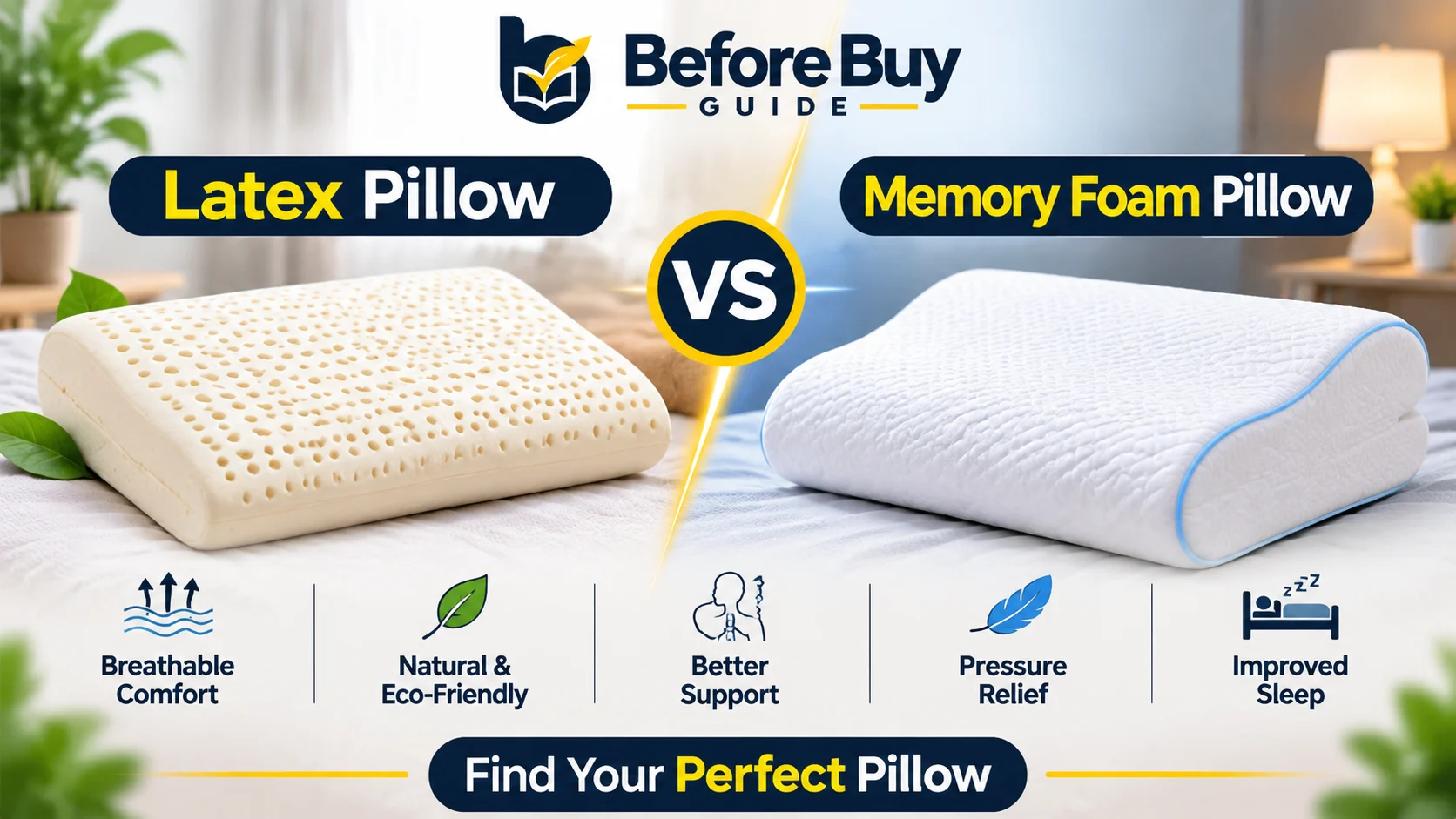
You’re standing in the pillow aisle, or scrolling a dozen tabs, and the same question keeps popping up: should you buy a latex or memory foam pillow? Both promise better sleep. Both come in a wide range of prices. And the product pages mostly tell you how great they are, not how they’re different.
This guide fixes that. We’ll walk through how a latex vs memory foam pillow actually differs in feel, support, cooling, lifespan and price, then help you match one to your sleeping position and your specific problems, whether that’s a stiff neck, night sweats or allergies. By the end, you’ll know which one to put on your shortlist and what to check before you click “buy.”
The Quick Answer
Stuck on latex vs memory foam pillow? Here’s the shortest path to an answer.
Choose latex if you sleep hot, want a bouncy and responsive feel, switch positions a lot, or prefer a natural material that tends to last longer.
Choose memory foam if you want a slow, hugging feel, deeper pressure relief, or a lower price, and you don’t mind a pillow that holds a little more warmth.
Skip latex if you have a latex allergy. Talk to your doctor if you’re not sure.
That’s the short version. The rest of this guide explains why, so you can make the call with confidence.
Quick-Pick Table
Swipe or scroll to compare all columns
If you… | Lean toward | Why |
|---|---|---|
Sleep hot or wake up sweaty | Latex | Open-cell structure generally lets air move through more easily |
Want that “sinking in” hug | Memory foam | It softens with body heat and molds slowly |
Toss and turn a lot | Latex | It springs back fast, so it’s easy to shift around on |
Share a bed with a restless partner | Memory foam | It tends to absorb movement better |
Have dust mite allergies | Latex (if you’re not latex-allergic) | Naturally resistant to dust mites and mold |
Have a latex allergy | Memory foam | Avoids latex entirely |
Want a lower upfront price | Memory foam | Generally less expensive at similar quality |
Care about natural materials | Natural latex | Made from rubber tree sap, unlike petroleum-based foam |
What Is a Latex Pillow?
A latex pillow is made from latex foam. The foam has a springy, buoyant feel. When you press into it, it pushes back and returns to shape quickly. Think of it as a pillow that lifts your head rather than letting it sink.
Natural, synthetic and blended latex
Natural latex comes from the sap of rubber trees. Synthetic latex is made from petroleum-based compounds, and blended latex mixes the two. Natural latex is usually the pricier option and is the one people choose when they want a more eco-conscious material. Synthetic and blended versions can feel more uniform and cost less, but they’re not the same product, so check the label before you assume “latex” means “natural.”
Talalay vs Dunlop
These are the two main ways latex foam is made, and they feel different.
Dunlop is typically denser and heavier, with a firmer, more supportive feel.
Talalay is typically lighter and airier, with a softer, more consistent feel.
If a product page doesn’t say which process it uses, that’s worth asking about. It affects both firmness and weight.
Shredded vs molded
A molded latex pillow is one solid piece. It’s firm and holds its shape, which many back and side sleepers like. A shredded latex pillow is filled with small pieces, so you can usually add or remove filling to adjust the height. That adjustability is a big plus if you’re between sizes.
What Is a Memory Foam Pillow?
Memory foam is viscoelastic polyurethane foam. In plain English, it softens in response to heat and pressure, then slowly returns to its original shape. That slow response is what creates the contouring, “hugging” feel people either love or find too stuck-in.
Solid vs shredded
A solid memory foam pillow gives you a defined shape and consistent support, and contour designs have a dip for your head and a raised area for your neck. A shredded memory foam pillow is made of small chunks. It feels lighter, shifts more easily and can be adjusted by changing the amount of fill.
Standard, gel-infused and ventilated
Standard memory foam is known for holding heat. To address that, makers add gel, copper or other infusions, or build in ventilation holes and open-cell designs. These can help, but results vary by product, and no memory foam pillow works exactly like latex when it comes to airflow. If you sleep very hot, treat cooling claims as a starting point, not a guarantee.
What CertiPUR-US does (and doesn’t) tell you
You’ll often see a CertiPUR-US label on memory foam. It’s a certification program that covers foam content and emissions standards, such as limits on certain chemicals and low volatile organic compound emissions. It’s a useful sign of baseline quality, but it isn’t a promise that a pillow is chemical-free, and it says nothing about comfort. Check the certifier’s own website to confirm a product is actually certified.
Latex vs Memory Foam Pillow: Side-by-Side Comparison
Here’s how a memory foam vs latex pillow stacks up on the things people actually care about: feel, cooling, durability and price.
Swipe or scroll to compare all columns
Feature | Latex Pillow | Memory Foam Pillow |
|---|---|---|
Feel | Bouncy, responsive, buoyant | Slow, contouring, “sinking” |
Support | Pushes back; lifts the head | Cradles; molds to your shape |
Pressure relief | Good, with a lighter touch | Typically deeper and more targeted |
Cooling | Generally breathes better | Tends to hold more heat, even with gel |
Motion isolation | Moderate; the bounce can transfer movement | Typically better at absorbing movement |
Durability | Often lasts longer | Often softens or flattens sooner |
Weight | Heavier | Lighter (especially shredded) |
Smell | Faint rubber scent at first, usually fades | “Off-gassing” odor at first, usually fades |
Allergens | Resists dust mites and mold, but not safe for latex allergy | No latex; look for certifications |
Materials | Natural, synthetic or blended | Petroleum-based polyurethane |
Price | Usually higher | Usually lower, with a wide range |
Adjustable loft | Shredded versions only | Shredded versions only |
One thing worth pointing out about the latex vs memory foam pillow debate: both materials come in good and bad versions. A well-made memory foam pillow can beat a cheap blended latex one, and the reverse is true too. Material is the starting point, not the whole story. When you’re choosing a latex or memory foam pillow, fit, height and the return policy matter just as much.
Latex or Memory Foam Pillow: Which Is Better for Your Sleeping Position?
Your position matters more than most people realize, because it decides how much space your pillow has to fill between your head and the mattress.
Side sleepers need a pillow that fills the gap between ear and shoulder so your head stays level with your spine. That usually means a higher, firmer pillow. When it comes to a latex or memory foam pillow for side sleepers, molded latex is a strong match because it holds its height. Memory foam works well too, especially a contoured style or a shredded one you can adjust. For a deeper dive, see our guide to the best pillows for side sleepers.
Back sleepers generally do best with a medium loft that supports the natural curve of the neck without pushing the head forward. Memory foam with a neck contour is a popular pick. A medium-height latex pillow is a good option if you want more bounce and cooling.
Stomach sleepers need a low, soft pillow so the neck isn’t forced into an upward angle. A thin shredded memory foam pillow, or a low shredded latex one with some filling removed, is usually the better fit. A thick, firm pillow is rarely a good idea here.
Combination sleepers change positions all night, so a pillow that’s easy to move around on helps. Latex’s quick rebound is a real advantage because you’re not fighting the foam each time you roll over. A shredded pillow can also work well since it reshapes with you.
Latex vs Memory Foam Pillow for Specific Problems
Best Pillow for Neck Pain: Latex or Memory Foam?
You’ll see plenty of sites claim that memory foam is the best pillow for neck pain, and others say the same about latex. The honest answer is that height and firmness usually matter more than the material. A pillow that keeps your neck neutral, not tilted up or sagging down, is the goal. Memory foam’s contouring helps some people feel more supported, and latex’s steady lift works better for others. If you have persistent or severe neck pain, numbness, or pain that travels into your arms, check in with a healthcare professional rather than relying on a pillow to fix it.
Cooling Pillow for Hot Sleepers
If heat is your main complaint and you want a cooling pillow, latex is usually the safer bet because its structure tends to let air move through more easily. Gel or ventilated memory foam can narrow the gap, but it’s less predictable. Whichever you choose, a breathable pillowcase makes a real difference, and so does the rest of your bedding.
Hypoallergenic Pillow Options (and a Latex Allergy Warning)
Latex is naturally resistant to dust mites and mold, which is a point in its favor if those trigger your symptoms. But “hypoallergenic” isn’t the same as “allergy-proof.” If you have a known latex allergy, avoid latex pillows. If you’re not sure, ask your doctor or an allergist before buying. Memory foam is the obvious alternative in that case. Either way, a washable pillow protector helps keep dust mites down.
Couples and restless partners
In the latex pillow vs memory foam pillow matchup for couples, memory foam tends to absorb movement, so you’re less likely to feel your partner shifting around. Latex is bouncier, which can pass more movement along. That said, pillow motion matters far less than your mattress, so don’t let it be the deciding factor.
Weight and portability
Latex pillows are noticeably heavier than memory foam ones. That’s fine if the pillow stays on your bed. If you travel with it, or if lifting heavy things is hard for you, a shredded memory foam pillow is easier to handle.
Three Quick Scenarios
These are hypothetical examples to show how the choice can play out. They are not reviews or test results.
The hot side sleeper. Wakes up sweaty and needs a taller pillow. A molded or shredded latex pillow with enough loft is a sensible first look.
The back sleeper with a stiff neck. Needs medium loft and gentle contouring. A contoured memory foam pillow is a reasonable place to start, but getting the height right matters more than the label.
The light sleeper with a restless partner. Memory foam’s slower response may help absorb movement. Just remember the mattress usually matters more than the pillow here.
The allergy-prone shopper. First rule out a latex allergy. If that’s clear, latex’s resistance to dust mites is appealing. If not, a certified memory foam pillow with a washable protector is the safer route.
How to Pick the Right Pillow Height (Loft)
Here’s something most “latex vs memory foam pillow” articles skip: a perfect material in the wrong height will still feel wrong. Use these as general starting points, then adjust for your body.
Swipe or scroll to compare all columns
Sleeping position | General loft range | Notes |
|---|---|---|
Side | Higher (roughly 4–6 inches) | Broader shoulders usually need more height |
Back | Medium (roughly 3–5 inches) | Avoid pushing your chin toward your chest |
Stomach | Low (under about 3 inches) | Keep your neck as flat as possible |
These ranges are common industry guidelines, not strict rules. Your mattress also matters. On a softer mattress, your body sinks in more, so you may need a lower pillow. On a firm one, you may need a higher pillow.
A simple home check: lie in your usual sleeping position and have someone look at you from the side (or take a photo). Your head and neck should look like a natural continuation of your spine, not bent up, down or sideways. For more on this, read our guide on how to choose a pillow.
Before You Buy: An 8-Point Checklist
This is where a lot of buyers get burned. Before you choose between a latex and memory foam pillow, run through these.
Check the return policy and sleep trial. A pillow feels very different after a few nights. Look for a trial window, and find out whether you can return it after opening it.
Confirm what the material really is. “Latex” could mean natural, synthetic or blended. “Memory foam” could include a thin foam layer over cheap filling. The product page should say.
Look at the construction. Solid or shredded? Dunlop or Talalay? A shredded pillow with a zipper lets you adjust the fill.
Verify certifications. Check the certifier’s own database for CertiPUR-US, OEKO-TEX or GOLS (Global Organic Latex Standard) claims rather than trusting a logo on a listing.
Check the loft and size. Make sure the height matches your sleeping position, and that it fits your pillowcases.
Read the care instructions. Some can’t be machine washed, which affects how long they stay fresh.
Compare the total cost. Add in replacement covers, protectors and how often you’ll likely need to replace it.
Be skeptical of big claims. Terms like “cools 10x better” or “cures neck pain” need a source. If the seller can’t explain how they measured it, treat it as marketing.
5 Mistakes to Avoid When Buying a Pillow
Choosing on material alone. The wrong height will feel wrong in either foam.
Judging it after one night. Give it a week or two before you decide.
Trusting cooling claims without a source. Ask how the seller measured it.
Skipping the return policy. A trial period is your safety net.
Assuming “natural latex” means 100% natural. Many products are blended, so read the label.
How Long Do They Last (and When to Replace Yours)
Latex tends to hold its shape longer than memory foam, but lifespans vary a lot by quality, how you sleep, and how you care for the pillow. Manufacturers often cite a range of a few years for memory foam and longer for natural latex, so check the specific brand’s warranty rather than trusting a general number.
Signs it’s time for a new one:
It stays flat or lumpy even after fluffing
You wake up with new neck or shoulder stiffness
Visible cracks, crumbling or a permanent dent
A lingering odor that doesn’t air out
It doesn’t spring back (for latex) or bounce back slowly (for memory foam) like it used to
The fold test: Fold the pillow in half and let go. A healthy latex or memory foam pillow should return to shape. If it stays folded or springs back unevenly, it’s worn out.
Care, Smell and Break-In Tips
New smell: Both materials can have a smell when unpackaged. Memory foam is often described as off-gassing, and natural latex can have a mild rubber scent. Airing the pillow out in a ventilated room for a day or two usually helps. If a strong odor lingers, contact the seller.
Break-in period: Give a new pillow at least a week or two before judging it. Your neck needs time to adjust.
Cleaning: Don’t assume you can toss it in the wash. Many foam pillows are spot-clean only, and heat and soaking can damage them. Use a removable cover and a pillow protector, and always follow the manufacturer’s care label.
Daily upkeep: Fluff shredded pillows regularly to keep the fill from settling, and let them air out from time to time.
Myths vs Facts
Myth: Memory foam is always best for neck pain. Fact: Alignment depends on height and firmness more than on material.
Myth: Latex is hypoallergenic, so everyone can use it. Fact: It resists dust mites and mold, but a latex allergy is a real reason to avoid it.
Myth: Gel memory foam sleeps cold. Fact: It can feel cooler at first, but results vary, and it may still hold more heat than latex.
Myth: A higher price means a better pillow. Fact: Price can reflect natural materials and construction, but a well-fitted mid-priced pillow often beats a poorly fitted expensive one.
Latex vs Memory Foam Pillow: So, Which One Should You Buy?
Go with a latex pillow if:
You sleep hot
You like a springy, responsive feel
You change positions often
You want a natural material and a longer-lasting pillow
You’re okay paying more up front
Go with a memory foam pillow if:
You love a slow, contouring hug
You want deeper pressure relief
You’re on a tighter budget
You share a bed with a light sleeper
You have a latex allergy
Still torn between a latex and memory foam pillow? If you can, pick one with a generous return policy and give it a fair trial. Comfort is personal, and the best test is how you feel after a couple of weeks.
Frequently Asked Questions
Is a latex pillow better than a memory foam pillow? Not across the board. Latex tends to be cooler, bouncier and longer-lasting. Memory foam tends to be more contouring and less expensive. The better one depends on your sleeping position, temperature and budget.
Do memory foam pillows get hot? Standard memory foam can hold heat because it softens with body warmth and hugs closely. Gel-infused and ventilated versions can help, but results vary by product.
Which pillow is better for neck pain, latex or memory foam? Neither is guaranteed to help. A pillow with the right height and firmness for your sleeping position matters most. See a healthcare professional for persistent pain.
Are latex pillows good for side sleepers? Yes, especially molded or higher-loft options that fill the space between your ear and shoulder. A shredded latex pillow can also work because you can adjust the height.
Are latex pillows good for allergies? Natural latex resists dust mites and mold, which helps some people. But if you have a latex allergy, avoid it.
How long do latex and memory foam pillows last? It depends on quality and care. Latex often outlasts memory foam, but check the warranty and watch for signs of wear.
Can you wash a latex or memory foam pillow? Most can’t be machine washed. Spot clean the foam, and wash the removable cover according to the care label.
Why does my new memory foam pillow smell? That’s typically off-gassing from the manufacturing process. It usually fades after airing the pillow out for a few days.
What’s the difference between Talalay and Dunlop latex? Dunlop is generally denser and firmer. Talalay is generally lighter, airier and softer.
Research notes
Sample framework- Basis of this page
- Illustrative research framework; no hands-on testing claimed.
- Source documents
- No source documents are listed for this sample.
- Commercial context
- Eligible links may earn a commission. A retailer listing does not establish a health benefit.